Understanding the Legal Maze: Why Hemp Products Have Everyone Confused
The hemp products legal status is set for a dramatic shift in 2025. Here's the breakdown:
Quick Answer: Federal vs. State Reality
- Currently Legal (Until Nov 2026): Hemp-derived products with 360.3% Delta-9 THC by dry weight are federally legal under the 2018 Farm Bill.
- New Federal Ban Coming: On November 12, 2026, a new law takes effect limiting products to 0.4mg total THC per container, eliminating 95% of current hemp products.
- State Laws Vary: Some states already ban hemp-derived THC, while others allow it with restrictions.
- Bottom Line: What's legal in your state today may not be federally legal next year.
The hemp industry, a $28 billion market born from the 2018 Farm Bill, now faces what economists call an "extinction-level event." New federal legislation redefines legal hemp to include total THC (Delta-8, Delta-9, THCA, etc.), not just Delta-9. This change means most high-potency products, like 10mg Delta-9 gummies or THCA flower, will become federally illegal by November 2026.
This creates massive confusion for consumers seeking legal, lab-tested cannabis without a medical card. Is that hemp gummy still legal in Florida? What about THCA flower? The answers are changing fast.
The reality is messy. Federal law says one thing. State laws say another. And the clock is ticking.
I'm Selena Jochumsen. Through my work at Greenhouse Girls Dispensary and with the National Cannabis Industry Association's Hemp Committee, I've steerd these hemp products legal challenges firsthand. My goal is to clarify what's legal now, what's changing, and how you can stay compliant while supporting ethical cannabis businesses.

Key terms for Hemp products legal:
- Small family farms
- Is Florida allowed to consume CBD products
The 2018 Farm Bill: How a "Legal Loophole" Birthed a Billion-Dollar Industry
To understand today's complex hemp products legal status, we have to go back to 2018. That's when The Agriculture Improvement Act of 2018, or the 2018 Farm Bill, accidentally created a $28 billion industry.
Before this, all cannabis was an illegal Schedule I drug. The Farm Bill distinguished hemp from marijuana, defining legal hemp as Cannabis sativa L. with no more than 0.3% Delta-9 THC on a dry weight basis. Anything over that limit remained illegal marijuana.
This 0.3% distinction removed hemp from the Controlled Substances Act, turning it into an agricultural commodity. Farmers could grow it, businesses could process it, and products could be shipped across state lines. The market exploded, moving beyond CBD to a wider range of products for our customers in Palm Harbor, Oldsmar, and across Florida.
The Dawn of Federally Legal THC
The DEA's descheduling of hemp was an economic lifeline for small family farms. For the first time in a century, cannabis could legally cross state lines, creating a real economic boom.
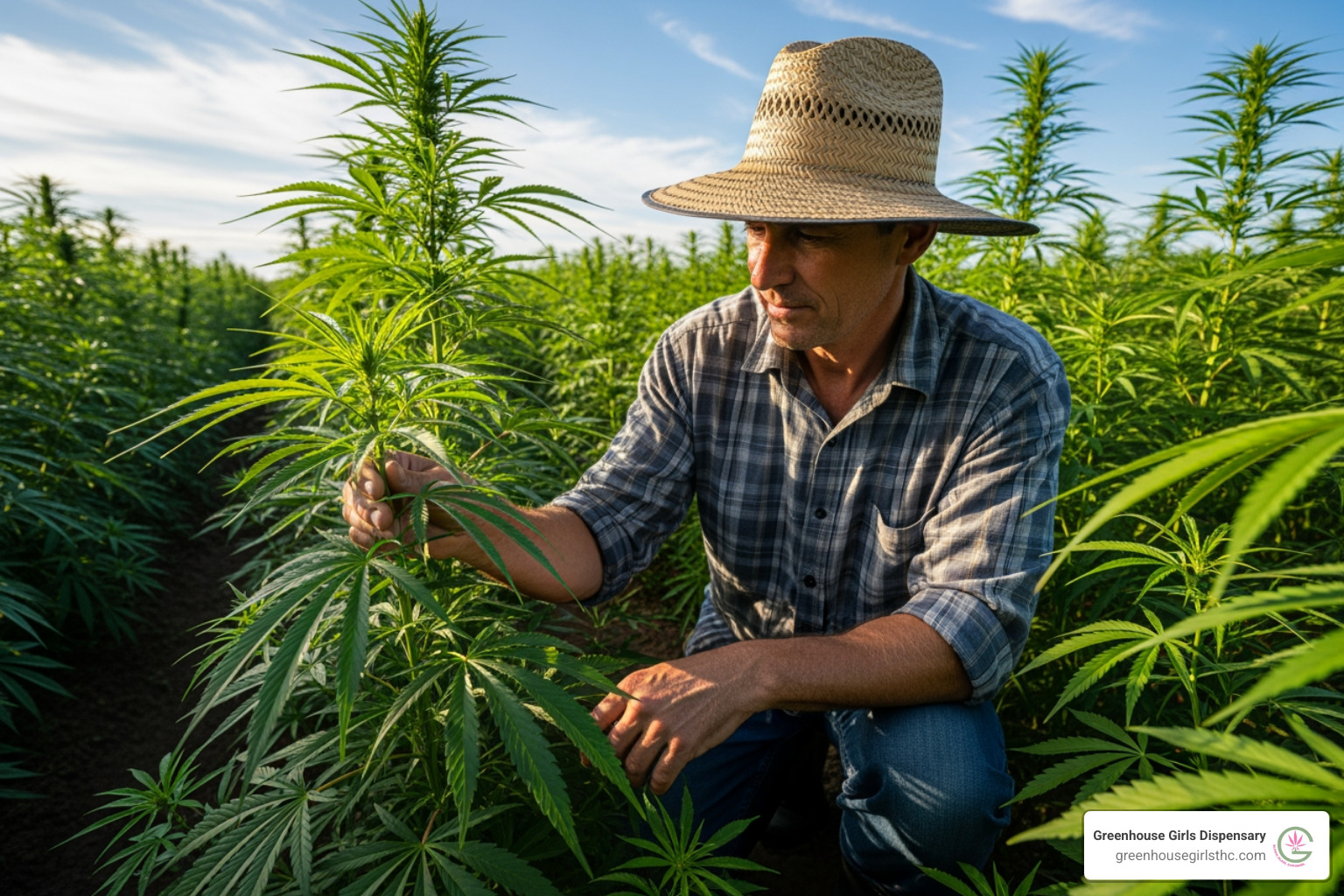
At Greenhouse Girls Dispensary, this allowed us to source quality flower, prerolls, and edibles from trusted small family farms, ensuring our products were federally compliant and high-quality.
But the 2018 Farm Bill's focus on only Delta-9 THC created a "legal loophole." It didn't regulate other cannabinoids, which the industry creatively explored. The law's message was simple: stay under 0.3% Delta-9 THC. Learn more in our guides on Hemp-Derived vs. Marijuana-Derived Cannabis and Why Hemp Gummies Get You High.
From CBD to Intoxicating Cannabinoids
Initially, the market focused on non-intoxicating CBD, which is what Congress thought it was legalizing. But unintended consequences soon followed.
Chemists realized the law only regulated Delta-9 THC, leaving other cannabinoids like Delta-8 THC and THCA unregulated because lawmakers hadn't anticipated them.
Delta-8 THC was the first breakthrough. Through a process called isomerization, abundant CBD could be converted into psychoactive Delta-8. This created intoxicating hemp products legal under federal law.
Next came THCA (tetrahydrocannabinolic acid), the non-intoxicating precursor to THC found in raw cannabis. When heated (smoked, vaped, or baked), THCA converts to psychoactive Delta-9 THC. Since the Farm Bill only measured Delta-9 in the dry plant, THCA flower could be legally compliant while still delivering potent effects.
This innovation led to popular products like high-potency Delta-9 gummies and THCA flower, meeting huge consumer demand, especially in states without recreational cannabis. People sought legal cannabis for relaxation and as an alcohol alternative. At Greenhouse Girls, our lab-tested THCA flower and 25mg Delta-9 gummies, sourced from small family farms, became favorites. We ensure compliance and safety, and currently offer a free Baby Jay preroll with your first visit. The industry operated within the law Congress created, but that law was about to change. Learn more in our guide, Demystifying Hemp: What You Need to Know About THCA and Delta Compounds.
A Federal Crackdown Looms: What the New Hemp Law Changes
Just when the rules seemed clear, a "stealth policy reversal" occurred. In late 2025, new federal legislation was quietly tucked into a government spending bill. This move directly attacks the hemp products legal framework created by the 2018 Farm Bill.

The law, enacted on November 12, 2025, has a one-year implementation deadline. The new restrictions take effect on November 12, 2026, giving the industry a short window to adapt or face closure.
For businesses like ours, built on compliant products like lab-tested THCA flower and Delta 9 gummies from small farms, this is devastating. Experts call it an "extinction-level event," as it effectively bans most consumable hemp-derived THC products nationwide.
The new law completely reshapes what hemp products legal means by:
- Redefining "legal hemp" to include total THC (Delta-9, Delta-8, THCA, etc.) under the 0.3% limit.
- Imposing a strict 0.4 mg total THC per container limit for consumables.
- Banning many synthesized cannabinoids.
- Overriding state laws with a stricter federal standard.
The clock is ticking for farmers, retailers like us in Palm Harbor and Oldsmar, and consumers. Confusion reigns over which products will remain legal. You can read more about the federal changes in official summaries and legislative text from government sources.
Redefining "Legal Hemp": The Shift to Total THC
The 2018 Farm Bill's narrow focus on 0.3% Delta-9 THC allowed the industry to flourish. Products like THCA flower and Delta-8 gummies were legal because the law didn't account for other intoxicating cannabinoids.
The new law closes this gap by requiring a total THC calculation. This means Delta-9, Delta-8, THCA, and other isomers are all added together and must remain under the 0.3% dry weight limit.
This is a massive shift. For example, our THCA flower, previously compliant with low Delta-9, could have 20% THCA. Under the new total THC rule, it would be far over the 0.3% limit. Farmers cultivating high-THCA or Delta-8 hemp face having their crops become federally illegal. The compliance challenges are enormous, threatening entire plant varieties. Learn more about THCA's legal status here: The THCA Truth.
The Per-Container Limit: A Ban on Most Edibles and Vapes
On top of the total THC redefinition, the new law delivers a knockout punch: a limit of just 0.4 milligrams of total THC per container for any consumable.
Our popular 25mg Delta 9 gummies contain over sixty times this new limit. Even a mild 2.5mg gummy would be illegal. Most THC beverages and vape cartridges would also be banned. Analysts estimate this limit alone will eliminate 95% of the current consumable hemp market. A product with only 0.4mg of total THC per container will have no noticeable effect, making it commercially unviable.
This provision also targets synthetic cannabinoids, closing the door on products like Delta-8 derived from CBD via isomerization. This is devastating for consumers who use hemp products as alcohol alternatives. The booming THC beverage market, covered in The Legal Lowdown on Cannabis Drinks, will be wiped out.
The reality is stark: by November 2026, most currently legal hemp products, including our 50mg Delta 8 gummies and popular shake deals, will be banned. We're in a race against time to adapt.
Are Hemp Products Legal? The Patchwork of Federal and State Regulations
The hemp products legal landscape is a confusing puzzle. A new federal ban adds another layer of complexity to the existing patchwork of state laws. While the 2018 Farm Bill legalized hemp federally, it allowed states to create their own rules.
For example, hemp-derived THC drinks are legal in some states but banned in others. This has led to claims of unfair competition from licensed marijuana businesses, who argue that unregulated hemp products ("gas station weed") have an advantage. The new federal ban aims to create a single, strict standard, but it may just increase federal-state conflicts.
How State Regulations for Hemp Products Differ
While federal law is tightening, states have varied approaches to hemp products legal status. For our customers in Florida, it's important to understand the current state rules.
Currently, Florida follows the 2018 Farm Bill, making hemp products with less than 0.3% Delta-9 THC legal. This allows us to offer products like Delta-9 gummies and THCA flower. Learn more in our guide: Are Delta-9 Gummies Legal in Florida? Yes, Here's Why.
Other states have taken different paths. Virginia, for example, limits consumable hemp products to 0.3% total THC and 2mg of total THC per package, unless there's a 25:1 CBD to THC ratio, with hefty $10,000 fines for violations. This shows a state-level effort to regulate potency and safety without a total ban.
Minnesota legalized infused food and drinks for adults in 2022, with some Target stores even selling THC drinks. This demonstrates a regulatory path. States like Colorado and Texas also have their own unique hemp programs, highlighting the complex and varied state-by-state approach to management. You can read about Colorado's plan on their Laws and Rules - Hemp page.
The FDA's Role and Consumer Safety
Amidst changing laws, the Food and Drug Administration (FDA) plays a crucial role. The 2018 Farm Bill legalized hemp but preserved the FDA's authority to regulate cannabis-containing products, which must meet FDA standards.
The FDA's primary concern is consumer safety. It has issued warning letters to companies for making unsubstantiated health claims about CBD and for inaccurate labeling, with some products containing unlisted THC.
While the FDA has approved some hemp seed ingredients as "Generally Recognized as Safe" (GRAS), regulating CBD in food and supplements is complex. It's currently illegal to add CBD to food or supplements, partly because it's an approved drug (Epidiolex), creating a regulatory barrier.
The lack of clear testing standards is another FDA concern, leading to potentially unsafe products on the market. The agency is exploring regulatory pathways for CBD, but this requires time and safety data. You can read the FDA's testimony on Hemp Production and the 2018 Farm Bill. The new federal ban could be seen as a heavy-handed attempt to simplify this complex issue.
The Great Debate: Regulation vs. Prohibition
The future of hemp products legal status is at the center of a fierce debate: regulation versus prohibition. With a federal ban looming, the answer will have massive implications for the economy, public health, and consumer access to cannabis.
The U.S. hemp-derived THC market is a $28 billion industry supporting 300,000 jobs. The new federal law's 0.4mg THC per container limit is projected to eliminate 95% of this market, putting livelihoods, tax revenue, and consumer choice at risk.
Here’s a quick look at the two sides of this debate:
| Feature | Federal Ban (Proposed) | Regulated Market (Advocated by Industry) |
|---|---|---|
| THC Limits | 0.4mg total THC per container; 0.3% total THC on dry weight basis | Higher potency limits (e.g., 2.5-10mg per serving) with clear labeling |
| Product Scope | Prohibits most edibles, vapes, and synthesized cannabinoids | Allows diverse product types, including intoxicating cannabinoids |
| Market Impact | Eliminates 95% of the $28B market; drives market underground | Fosters legal, taxed industry; reduces illicit market |
| Economic Impact | 300,000+ job losses; $1.5B+ lost tax revenue federally & state-wide | Job creation; significant tax revenue for states and federal government |
| Consumer Safety | Aims to eliminate "dangerous" products; potential for black market risks | Lab testing, age-gating, clear labeling, ingredient transparency |
| Industry Oversight | Blanket prohibition; minimal industry input | FDA-led regulation; industry collaboration; science-based standards |
Arguments for the Ban: Protecting Public Health
Supporters of the ban worry about the current state of hemp products legal availability. They often point to unregulated "gas station weed" sold without proper checks, arguing it can easily fall into the wrong hands.
A primary concern is protecting children, with reported spikes in calls to poison-control centers for pediatric exposure to THC from these products. Lack of strict age-gating makes them too accessible to minors.
Other worries include:
- Untested Products: Many products lack testing for safety, potency, or contaminants.
- Misleading Labeling: Unclear labels can lead to accidental intoxication.
- Synthesized Cannabinoids: The chemical process to create compounds like Delta-8 can leave behind harmful residues if not done properly.
From this perspective, a federal ban is a necessary step to clean up a messy market and prioritize consumer safety, especially for children.
Arguments Against the Ban: An "Extinction-Level Event"
Conversely, the hemp industry and many consumers view the ban as an "extinction-level event." They argue prohibition will cause massive economic harm and ultimately make consumers less safe.
The potential consequences are stark:
- Job Losses: An estimated 300,000 jobs are at risk.
- Lost Tax Revenue: An estimated $1.5 billion in annual tax revenue could be lost.
- Market Destruction: The ban would wipe out 95% of the $28 billion market, destroying billions in investments.
- Rise of the Black Market: Prohibition doesn't eliminate demand; it drives it underground. Consumers in Florida and elsewhere would be forced toward untested, unregulated, and more dangerous illicit products.
Industry leaders, including us at Greenhouse Girls Dispensary, advocate for sensible regulation over prohibition. We support mandatory lab testing, clear potency limits, child-resistant packaging, and strict age-gating—a transparent system that protects consumers while allowing legitimate businesses to operate. We already uphold these standards with our federally compliant, lab-tested THCa flower and Delta 9 gummies sourced from small family farms.
What's Next for the Hemp Industry and Consumers?
The clock is ticking toward the November 2026 implementation of the new federal law, creating palpable anxiety in the hemp products legal world. The one-year grace period offers a small window for adjustments, but the future remains uncertain.
The industry is fighting back with intense lobbying and legislative pushback. Rep. Nancy Mace (R-S.C.) has introduced a bill to repeal the ban, showing a congressional desire to reconsider. The outcome will determine the future availability of hemp products.
How Farmers, Retailers, and Consumers are Responding
The looming ban has sent shockwaves through the hemp industry, creating a tough time for everyone involved.
Farmers: The small family farms we source from face immense uncertainty, unsure if their crops will be legal to sell. This threatens future hemp cultivation.
Retailers: At Greenhouse Girls in Palm Harbor and Oldsmar, Florida, we are reviewing our inventory. Businesses are scrambling to reformulate products to meet the 0.4mg limit or clear non-compliant stock. The ban threatens our entire product range, from our popular flower (shake deals), 25mg Delta 9 and 50mg Delta 8 gummies, and prerolls to our vapes and drinks.
Consumers: You are understandably confused and concerned. Many are stocking up, while others seek clarity on what will remain legal. This uncertainty is frustrating, especially for those who rely on these products for wellness. Our guide can help: Navigating the Law: Are Your Delta-9 Gummies Above Board?.
The Path Forward: Can Regulation Save the Industry?
Most in the industry, including us at Greenhouse Girls Dispensary, believe sensible regulation is the only path forward. We need rules that protect consumers while allowing the legitimate industry to thrive.
The industry is advocating for a clear regulatory framework that includes:
- Age-Gating: Strict age verification to keep products out of the wrong hands.
- Mandatory Lab Testing: Rigorous third-party testing for potency, purity, and contaminants—a standard we already uphold.
- Standardized Labeling: Clear, consistent labels with all necessary information about THC content and ingredients.
- Max Potency Rules: Reasonable limits on intoxicating products to address safety concerns.
By modeling regulations on the alcohol and tobacco industries, we can build a safe, strong framework for hemp. This would allow businesses like ours to continue offering high-quality, legal cannabis alternatives. See how some states are already doing this: THC Regulations: Florida, Texas Updates.
Conclusion
The future of hemp products legal status is at a critical crossroads. The promise of the 2018 Farm Bill, which created a legitimate federal cannabis market, is now threatened by a federal crackdown that could dismantle the entire industry.
The shift to a total THC calculation and the restrictive 0.4mg per container limit is a move toward prohibition, not sensible regulation. While consumer safety is paramount, we believe there is a better path forward.
The statistics are sobering: 300,000 jobs at risk, $1.5 billion in lost tax revenue, and a $28 billion market decimated. Behind these numbers are small family farmers, retailers, and consumers who rely on this industry. Pushing consumers to the unregulated black market doesn't solve safety issues—it worsens them.
At Greenhouse Girls Dispensary, we do things the right way. Every product, from our federally legal, lab-tested THCa flower to our popular 25mg Delta 9 and 50mg Delta 8 gummies, is transparent and compliant. We source from small family farms and serve our Florida communities—from Palm Harbor to Tampa and beyond—with a commitment to quality and safety.
The coming year is crucial. We need sensible regulation—mandatory lab testing, age verification, clear labeling, and reasonable potency limits—not policies that destroy an industry. The alcohol and tobacco industries prove that thoughtful regulation works.
We are committed to compliance. Our full range of flower (including our popular shake deals), prerolls, edibles, vapes, drinks, and 420 merch will always meet the highest standards. Whether you visit us in Florida or order online with nationwide shipping, we're still offering a free preroll or gummy with your first visit so you can experience the quality firsthand.
The green light for hemp is flickering. Stay informed, support compliant businesses, and make your voice heard. To learn more, read The Definitive Guide to Hemp-Derived Cannabis. Together, we can advocate for a better approach that protects consumers and preserves this vital industry.